
Introduction
Are you throwing money away with every shipment?
For many businesses, especially in manufacturing, retail, FMCG, automotive, and e-commerce, packaging is often treated as a small operational detail—something inexpensive and unimportant. But this mindset silently drains money from your supply chain.
Corrugated boxes (cardboard boxes) seem cheap because of their low upfront price. You can easily buy them in bulk, use them once, and forget about them. But the recurring purchase and the hidden costs attached to them make corrugated packaging one of the biggest contributors to rising logistics expenses.
On the other hand, Reusable Plastic Packaging—also known as Returnable Transport Packaging (RTP)—is designed for long-term use and delivers measurable cost savings, better product protection, improved hygiene standards, and increased supply chain efficiency. And with pooling models, companies don’t even need to purchase these crates upfront.
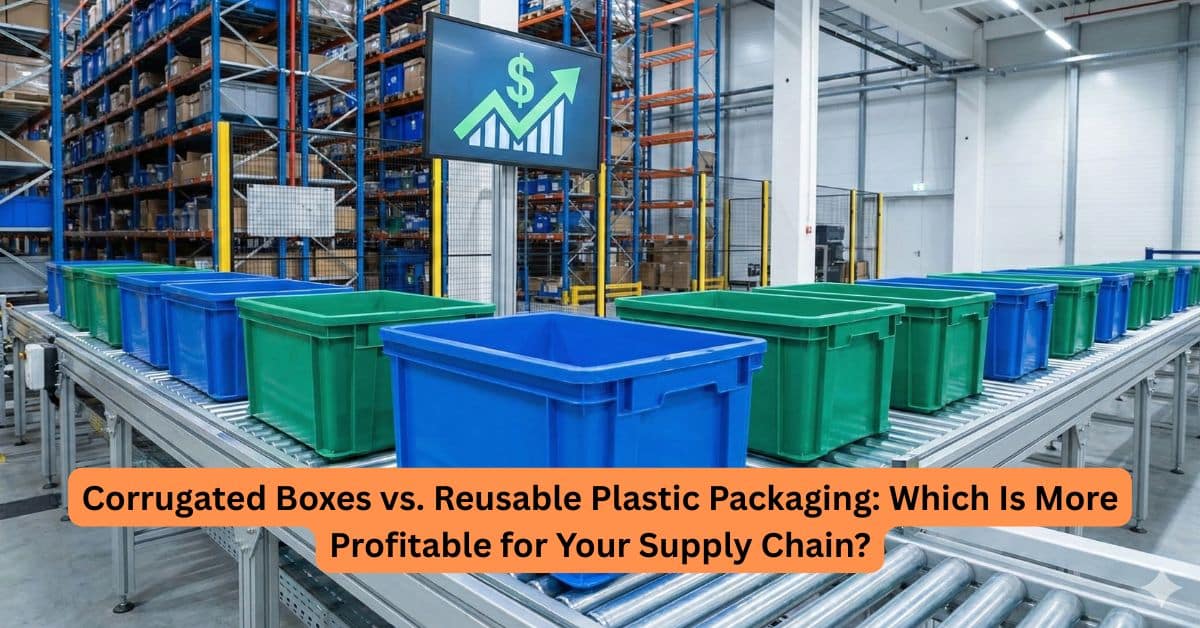
So, what truly gives you a higher packaging ROI—corrugated boxes or reusable plastic crates? Let’s break down the real numbers and operational impacts.
The Hidden Costs of Corrugated Boxes
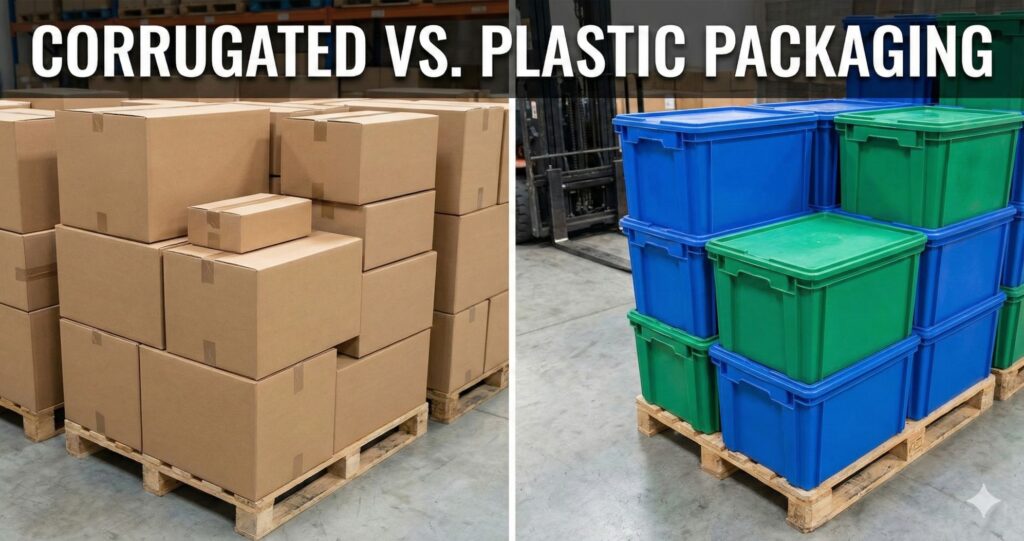
Corrugated boxes have dominated packaging for decades, but their weaknesses make them far more expensive in the long run than they appear on paper. Here’s why:
1. Single-Use Nature Increases Recurring Costs
A corrugated box is typically used only once.
That means you pay for it every time you ship. For companies with high shipment volumes, this results in:
- Continuous purchasing cycles
- Monthly spend on replenishment
- Storage space required for new boxes
- Increased procurement and supply chain overhead
Even if each box costs ₹20–₹40, imagine multiplying that cost across thousands of monthly shipments. Over a year, this balloons into lakhs of rupees spent simply on disposable packaging.
2. High Disposal & Waste Management Costs
Once used, cardboard becomes waste. It cannot be folded back, reused effectively, or sent again through the supply chain. Companies must pay for:
- Disposal fees
- Waste handling labour
- Recycling charges (if applicable)
- Environmental compliance
In industries with strict hygiene or sustainability guidelines, managing this waste becomes even more expensive.
3. Increased Product Damage
Cardboard is fragile. It crushes easily, tears during handling, and provides weak support for heavy or irregularly shaped items. This results in:
- Damaged goods
- Customer returns
- Replacement costs
- Loss in brand reputation
For fragile materials like auto components, electronics, glassware, or FMCG bottles, corrugated packaging often fails to offer the needed protection.
4. Moisture Absorption Reduces Product Safety
Corrugated boxes absorb moisture, humidity, and dust.
This is particularly harmful for:
- Automotive parts
- Electronic components
- Pharmaceutical supplies
- Food items
Not only does moisture damage the products, but it also weakens the box structure, increasing the risk of collapse during stacking or transportation.
5. Poor Stackability Leads to Higher Logistics Costs
Because corrugated boxes lose their shape easily, they:
- Cannot be stacked too high
- Occupy more warehouse space
- Lead to inefficient truck loading
- Increase cost per shipment
This is where companies unknowingly lose a significant amount of money—through poor space utilization in logistics.
Why Reusable Plastic Packaging (RTP) Wins
Reusable plastic crates and bins are engineered to handle the stress of repeated handling, stacking, and movement across complex supply chains. They offer long-term value and strong ROI.
1. Long Life Cycle (Hundreds of Trips)
A high-quality plastic crate can last 3–7 years, and withstand hundreds of trips without losing structural stability. The cost, when divided across trips, becomes extremely low.
For example:
A reusable crate costing ₹500 used for 200 trips = ₹2.5 per trip
Compared to corrugated boxes costing ₹25–₹40 per shipment = 10x higher cost
This direct comparison makes RTP the clear winner for cost reduction in logistics.
2. Superior Product Protection
Unlike corrugated boxes, plastic crates offer:
- Rigid walls
- Stable bases
- Impact resistance
- Edge and corner protection
- Optional partitions for sensitive parts
The result? Fewer breakages, minimum returns, and improved customer satisfaction.
3. Hygiene & Contamination Control
Plastic crates do not absorb:
- Water
- Dust
- Chemicals
- Oil
This makes them ideal for industries with strict hygiene standards, such as:
- Automotive
- Electronics
- Pharma
- Food and beverages
They can also be easily washed and sanitized, ensuring product safety.
4. High Stackability & Space Optimization
Plastic crates are designed to stack perfectly—even under load. Benefits include:
- Higher warehouse density
- Efficient truck loading
- Lower cost per shipment
- Better material flow in production
Even a 10–20% improvement in stacking efficiency can dramatically reduce logistics expenses.
5. Standardization in Supply Chain
Reusable packaging brings uniformity in:
- Handling
- Storage
- Transportation
- Automation compatibility
This improves operational speed and reduces labour errors.
The “Asset Pooling” Advantage (A Game Changer for Yantra Packs)
One of the biggest hurdles companies face while adopting reusable packaging is the high upfront cost of purchasing plastic crates, pallets, or bins. But with Yantra Packs’ Asset Pooling model, this problem disappears completely.
What Is Asset Pooling?
Instead of buying reusable crates, companies rent them from Yantra Packs on a pay-per-use or subscription basis.
Why Asset Pooling Is Better Than Purchasing?
1. No Capital Investment (Shift from CAPEX to OPEX)
Companies avoid spending lakhs or crores on packaging assets.
This frees up cash flow and makes the supply chain more flexible.
2. Pay Only for Usage
You pay only when crates are used in your supply chain.
No waste. No idle inventory cost.
3. Maintenance & Tracking Included
Yantra Packs handles:
- Washing
- Repairing
- Replacements
- Tracking & reverse logistics
This reduces operational burden.
4. Scalability Based on Business Demand
Whether your demand fluctuates seasonally or grows rapidly, pooling ensures you always have the right quantity of crates available without additional investment.
5. Guaranteed Availability of Standardized RTP Assets
Companies get access to high-quality, industry-standard reusable packaging—without buying a single unit.
Why This Model Delivers Maximum ROI
When you combine:
- Lower cost per trip
- Zero CAPEX
- Better product protection
- Higher logistics efficiency
- No maintenance cost
…you get the highest possible packaging ROI in the industry.
Conclusion
If your business operates in a closed-loop supply chain, the winner is clear: Reusable Plastic Packaging (RTP) delivers far better cost efficiency, logistics optimization, product protection, and long-term profitability than corrugated boxes.
Corrugated packaging may appear cost-effective initially, but its recurring costs, high damage rates, moisture sensitivity, and poor stackability make it the more expensive option in the long run.
With Yantra Packs’ Asset Pooling solutions, companies can enjoy the benefits of reusable packaging without any upfront investment—making the transition easier, faster, and financially smarter.
Ready to Reduce Your Packaging Costs?
Calculate your savings today. Switch to Yantra Packs’ Asset Pooling solutions and unlock a more efficient, profitable, and sustainable supply chain.

No comment